
Most voice AI demos are given in clean English, on a laptop microphone, with one caller. That is not how your calls will sound. A parent in Nagpur ringing about a fee will speak in Hinglish over a cheap phone. A results-day spike will put forty people on the line at once. And the sales head will ask the next morning where the call notes went.
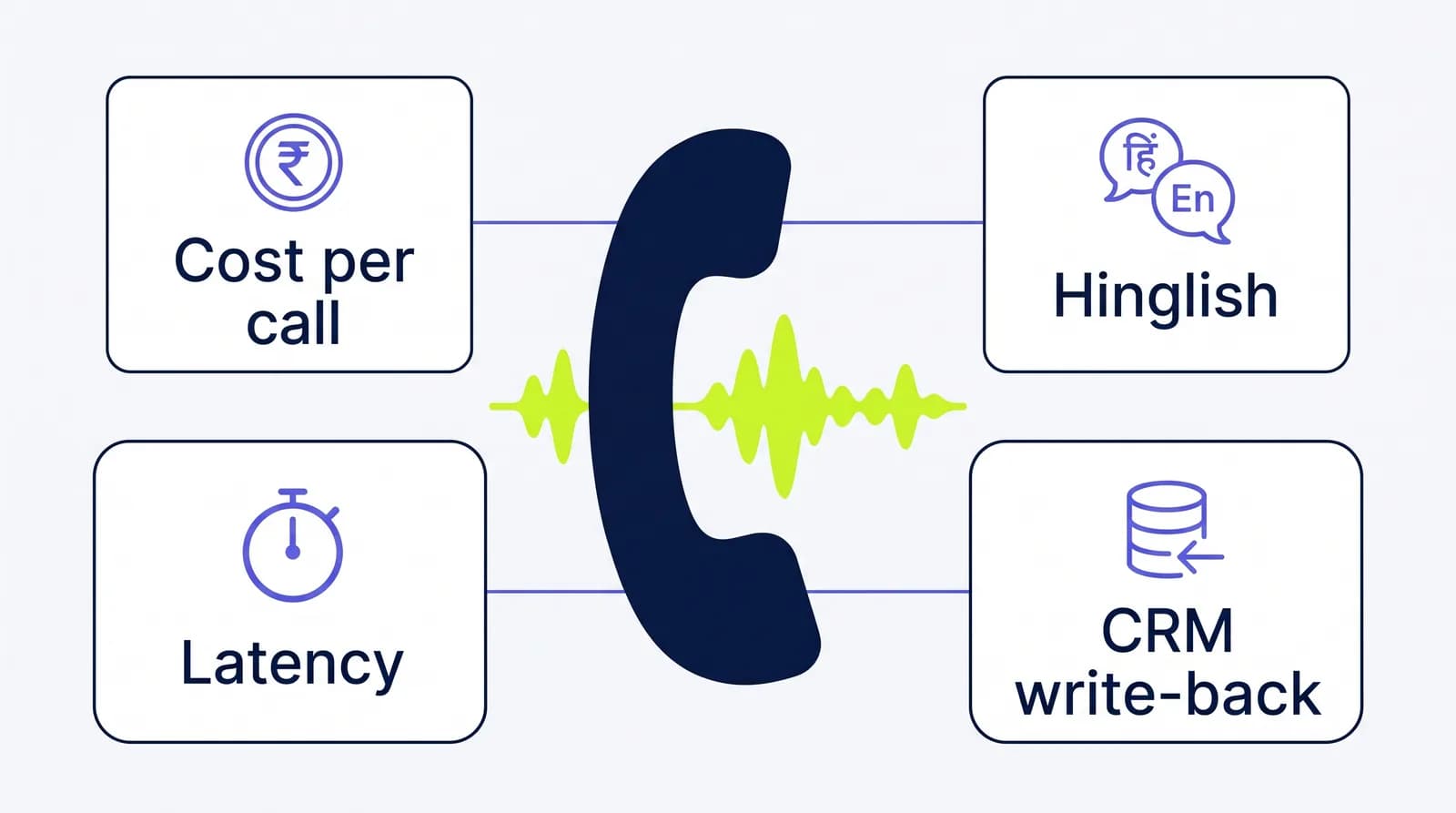
This guide covers the four questions that decide whether a voice AI pilot in India survives its first month: what a call really costs, whether it copes with Hinglish, how fast it replies, and what lands in your CRM. The advice comes from running our own AI voice agent platform on Indian phone lines, not from a vendor brochure.
What is voice AI in Indian languages? It is software that holds a phone conversation in Hindi, English, Marathi, Tamil, Telugu, Kannada or a mix of them, answers from your documents, and writes the result of each call into your business systems.
Teams comparing voice AI vendors or planning a pilot: admissions, collections, sales, HR and support heads, and the IT or procurement person who has to sign off. If you are still deciding which calls to automate, start with ten use cases for AI voice agents and come back here.
Cost per call: what to ask for
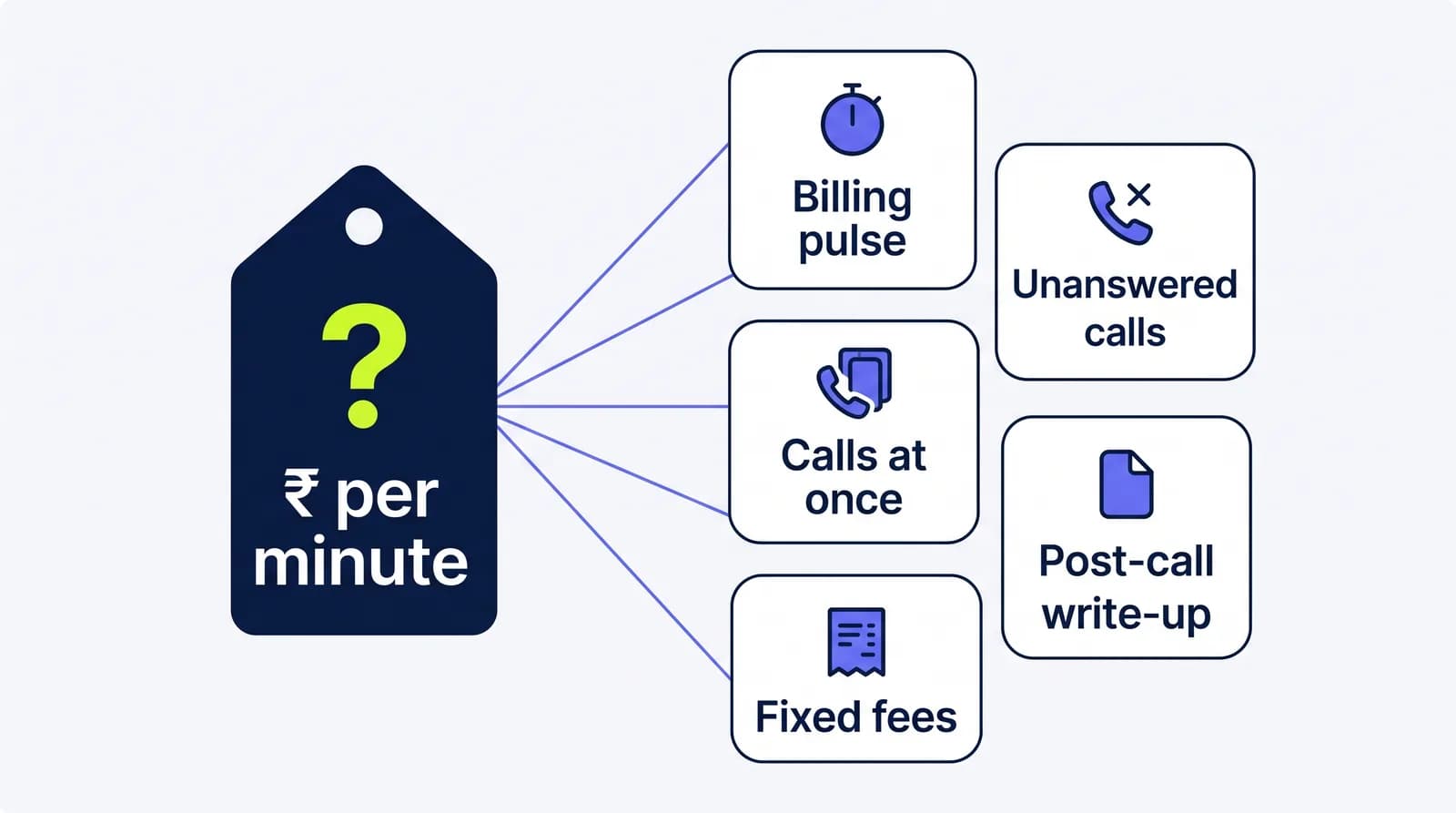
A per-minute price bundles several things: the AI that listens, thinks and speaks, the phone line, the write-up after the call, and the capacity to take several calls at once. Two vendors quoting the same rate can be selling very different bundles. Ask each one:
- What exactly is in the per-minute price? And is it billed per second, or in 30- or 60-second pulses?
- Are unanswered and dropped calls billed? On outbound campaigns a large share of dials never connect.
- How many calls at once does the price cover? And what do extra lines cost for a results day or a campaign peak?
- Is the post-call write-up included? The summary, score and CRM fields are the part your team will actually use.
- What are the fixed fees? Setup, integration, phone numbers and any monthly platform fee.
What a minute costs
The low end is high-volume, self-serve usage; the high end is a fully managed agent with integrations, monitoring and support.
Because the range is that wide, a rate on its own tells you little. Ask what is included before comparing vendors.
Compare cost per completed task, not cost per minute
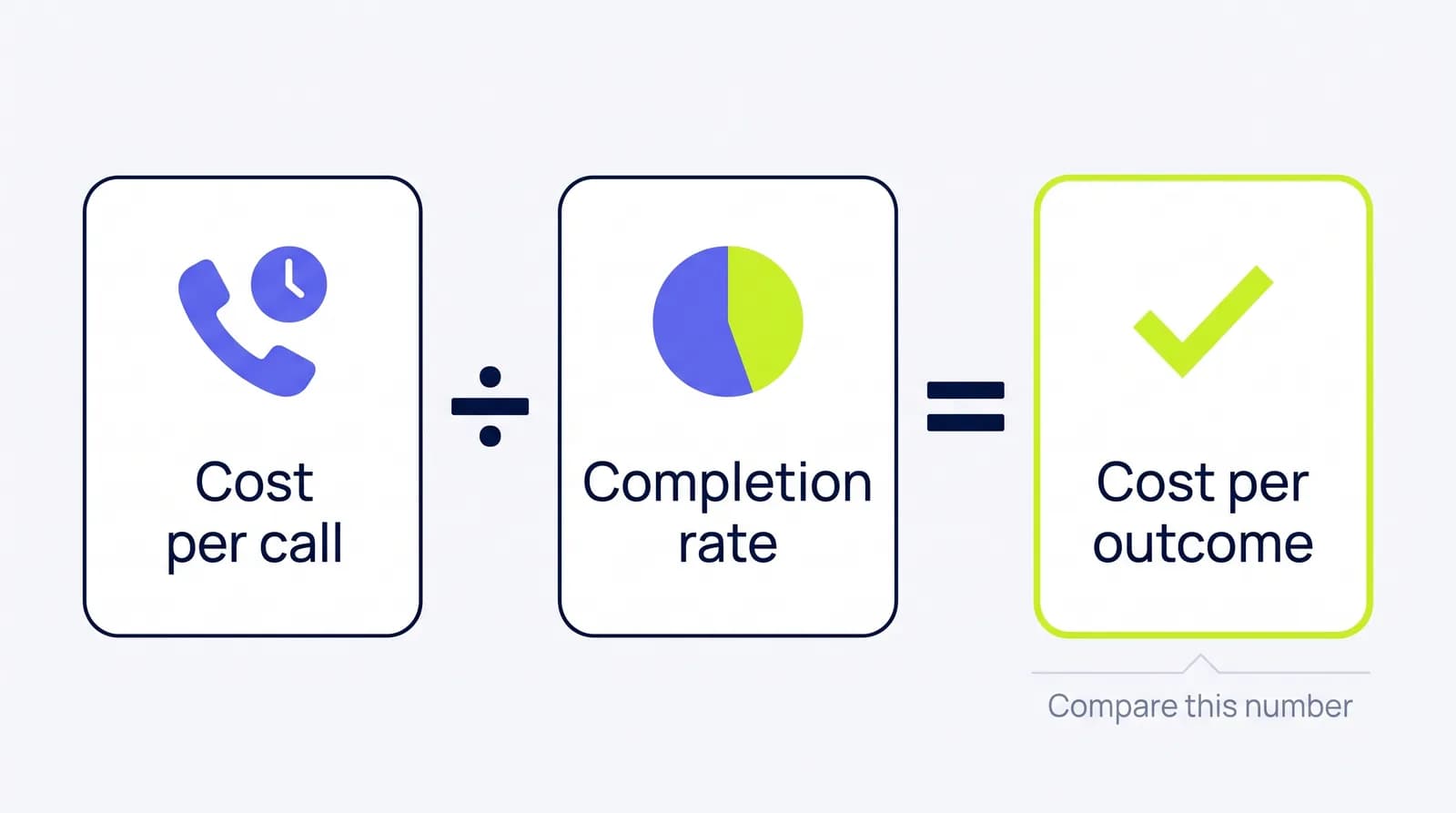
A cheap minute that ends with nothing done is expensive. Work out cost per outcome instead:
Cost per connected call
Average call length × per-minute rate. A two-minute fee reminder at ₹6 a minute is ₹12. Add the share of dials that do not connect if you pay for them.
Divide by the completion rate
If half the connected calls end with a payment date recorded, each recorded date cost ₹24.
Compare with what the outcome is worth
A recovered fee, a booked counselling session, a screened candidate. Compare with the cost of the same outcome from your team, including the calls that never got made.
Then add the one-time and fixed costs: setup and integration work, a monthly platform fee, each phone number, and extra concurrent channels for your peaks. These dominate at low volume and disappear at high volume.
Hinglish: how to test the language between the languages
Indian callers rarely pick one language. "Mera fee receipt abhi tak nahi aaya, can you check?" is one sentence, and an agent that hears it as broken Hindi or broken English loses the caller in the first thirty seconds.
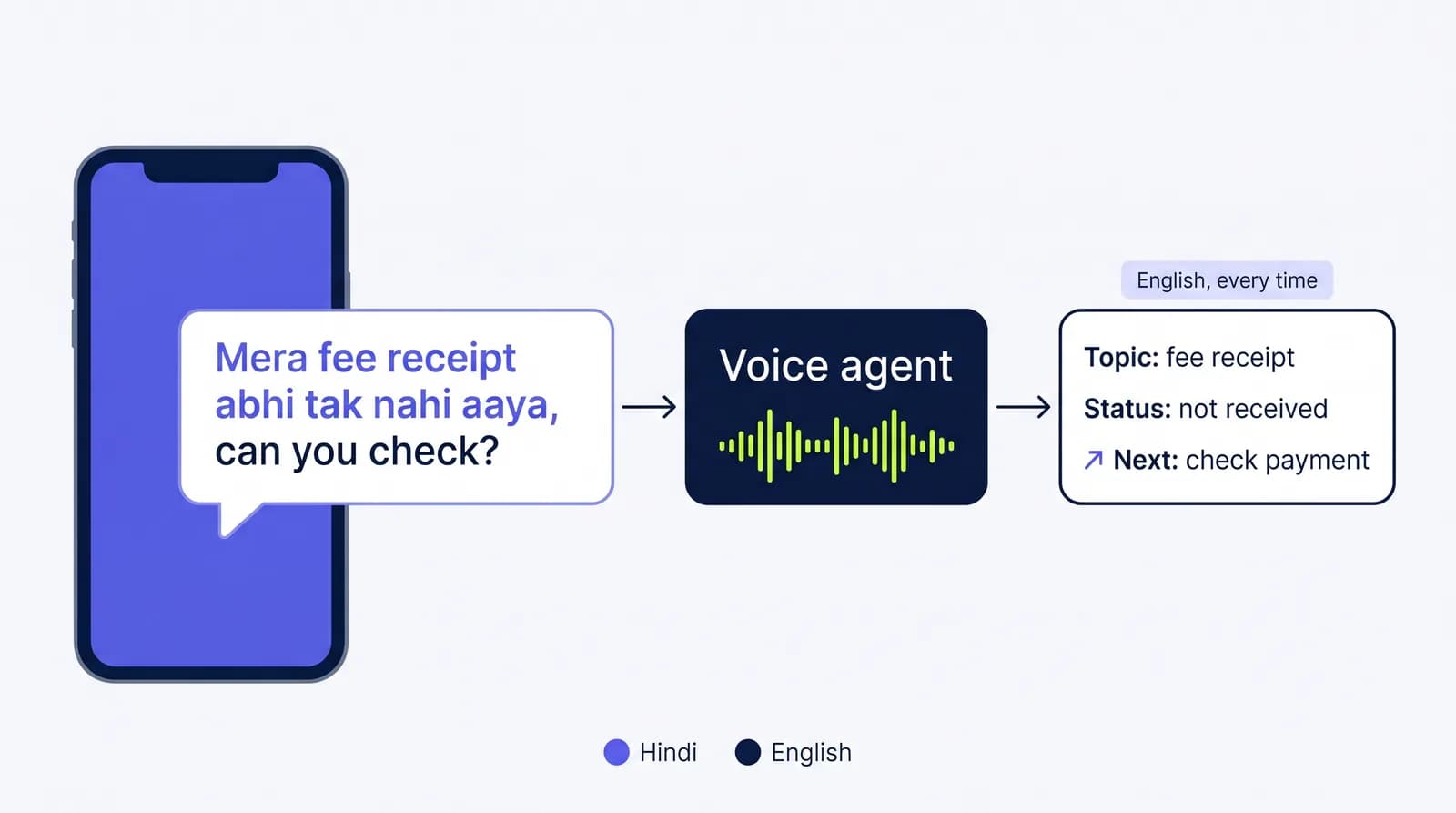
Code-mixed speech is still hard for machines. In the Interspeech 2021 code-switching challenge, baseline systems got roughly three in every ten words wrong on Hindi-English speech. Models have improved a lot since, but a vendor's list of supported languages tells you nothing about how well each one copes with the mix your callers use. Test it yourself.
Use real phone audio
Phone audio is far rougher than a demo. A test on a laptop microphone tells you nothing about a call from a moving bus. Run every test over an actual phone call.
Switch mid-sentence
Open in Hindi, ask the key question in English, answer in Hinglish. The agent should reply in the language the caller is using, not force a choice at the start.
Say your own words
Course names, product codes, branch names, the local name of a scheme. These are where recognition fails first, and where a knowledge base built from your documents helps most.
Test numbers and dates
"Teen hazaar paanch sau", "15 tareekh", a ten-digit application number. A good agent reads reference numbers back digit by digit, in small groups, and confirms them.
Check what lands in the CRM
The caller may speak Hinglish, but your team needs the summary and fields in English, in the same format every time. Check that, not just the transcript.
Our platform speaks English, Hindi, Marathi, Tamil, Telugu and Kannada, and follows callers who mix Hindi and English. We still ask every customer to test with their own callers before going live in a language.
Latency: how fast is fast enough
In conversation, people answer each other within a fraction of a second. Researchers comparing ten languages found that every one avoids both overlap and long silence, and the average gap varies by only about a quarter of a second between them. A caller notices a pause well before they can say why the agent "feels slow".
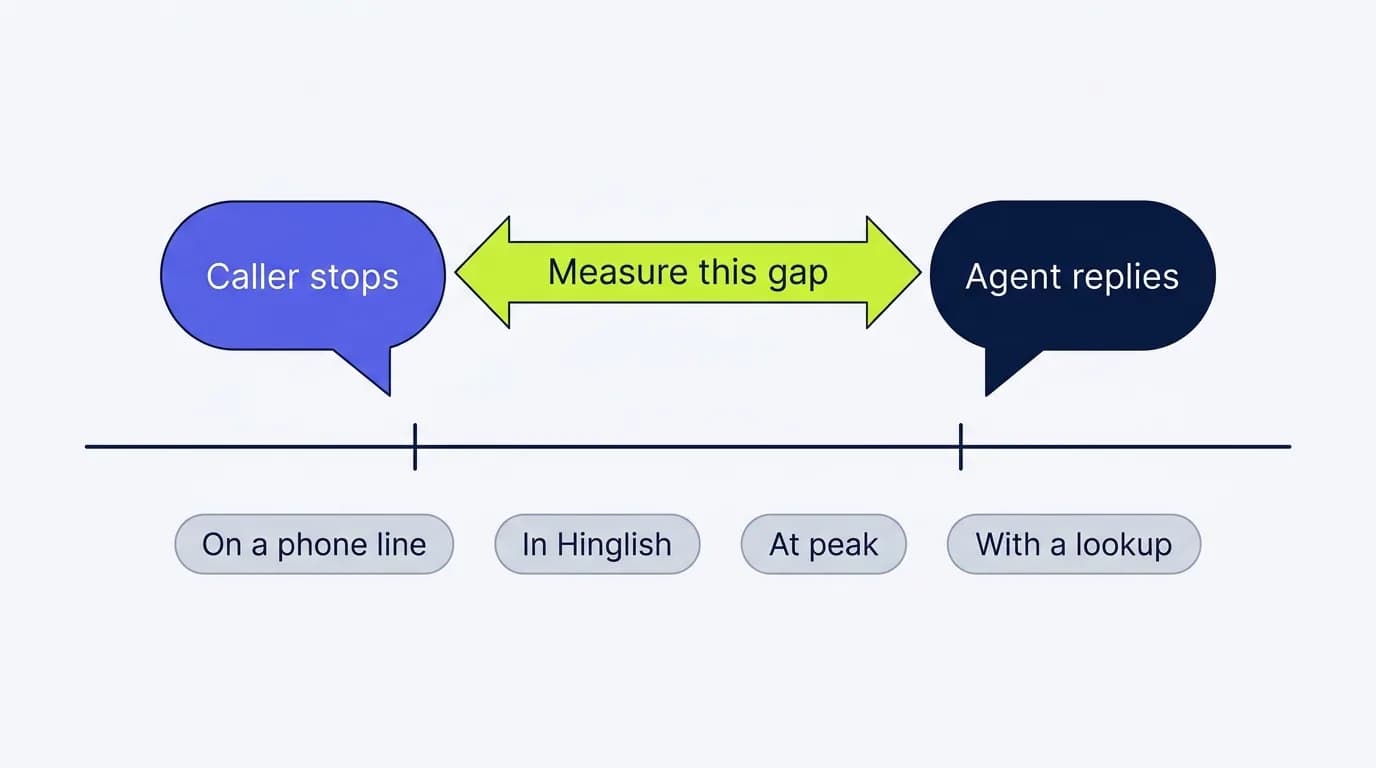
What a caller notices is the gap between finishing a sentence and hearing the agent reply. A good agent keeps that gap short without cutting people off mid-thought. That balance matters more in India, where callers often pause after "haan..." or "matlab..." and carry on.
Two behaviours matter as much as raw speed. Barge-in: when the caller interrupts, the agent should stop talking at once and listen. And short turns: an agent that speaks for thirty seconds without a breath feels slow, because the caller cannot get a word in. When the agent has to check a record, it should say so ("let me check that") rather than go silent.
How to measure it in a pilot
- Time the gap from the end of your sentence to the agent's first sound, on a real phone call, not in a browser demo.
- Test in Hindi and Hinglish as well as English, not just the demo language.
- Test at your peak. Ten calls at once can be slower than one.
- Test with a live lookup. "Has my fee been received?" is slower than "what are your timings?", and it is the question callers care about most.
- Interrupt the agent on purpose, twice. It should stop both times.
CRM write-back: what it should mean in your contract
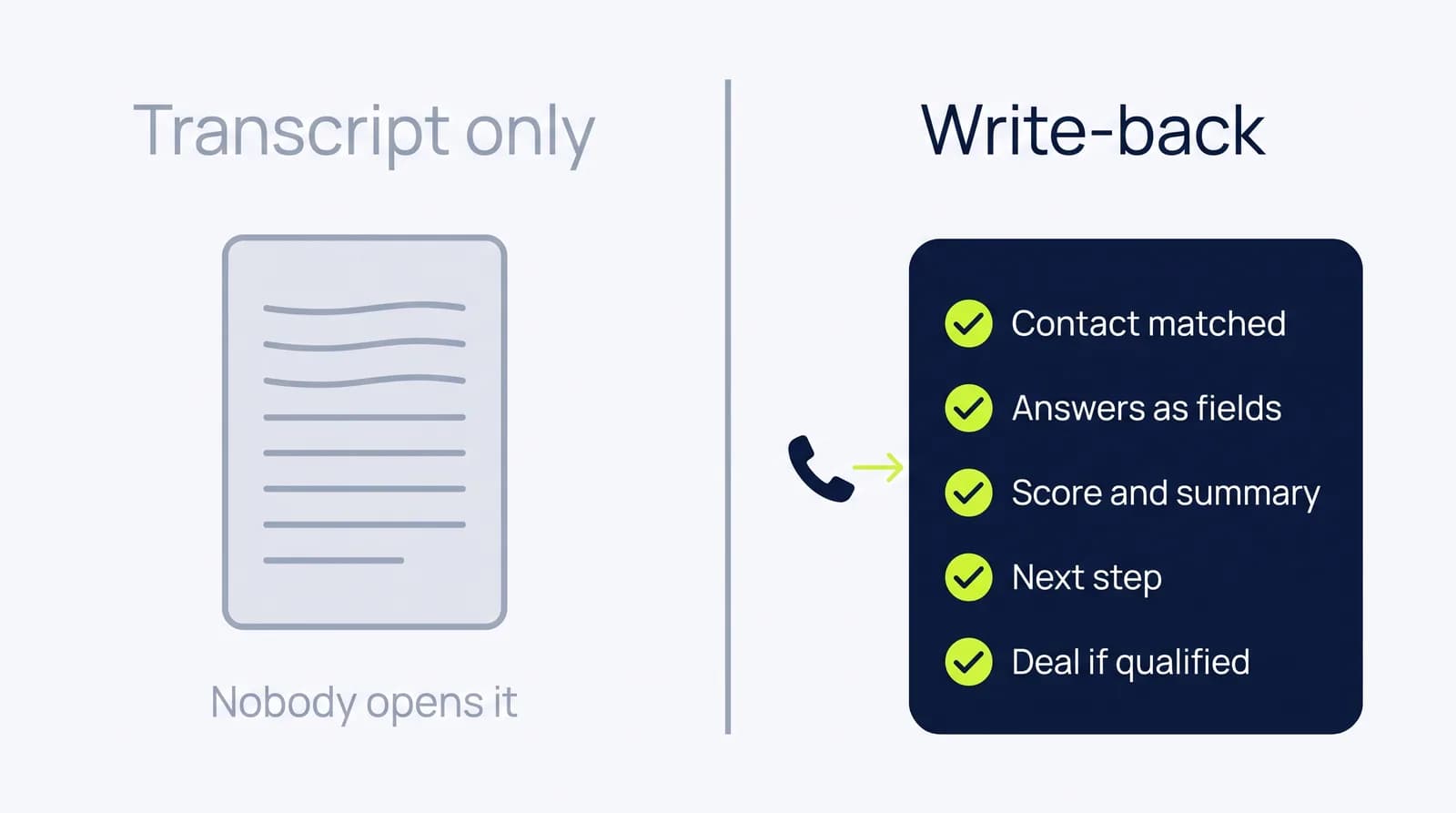
"Integrates with your CRM" can mean anything from "we email a transcript" to "we create the deal". Pin it down. The useful version writes fields, not documents, because nobody opens a transcript.
The contact, matched by number
Found or created by the caller's phone number in one standard format, so a second call does not create a duplicate. A withheld number should create a contact without unlocking anyone else's record.
Answers as fields
Course of interest, budget, timeline, payment date promised, reason for leaving. Each as its own CRM field your team can filter and report on.
Summary, score and next step
A short summary, a score against your criteria, the objections raised and the agreed next step, with the recording and transcript one click away.
A deal only when it qualifies
A deal or ticket created only when the call meets your rule, so the pipeline is not flooded with every curious caller.
Questions to ask before you sign:
- Read, write, or both? Looking a caller up mid-call and writing the result afterwards are different permissions, and some vendors only do one of them for a given CRM. Ask per system.
- What happens when the CRM is down? Write-back should retry and log failures, not drop the call silently.
- Is the webhook signed? If results reach your own system by webhook, each request should carry a signature your system can verify.
- What can the agent touch? An agent allowed to update a call outcome should not be able to edit a payment. Ask for field-level scope.
On our platform, each call goes to HubSpot (contact, call note, and a deal when the caller qualifies) or to any system through a signed webhook. Agents can look callers up in Salesforce, HubSpot or Zoho CRM during the call, only for the number they are calling from. See the inbound voice agent for lead qualification for the full list.
Compliance belongs on the scorecard
A voice AI pilot in India more often fails a compliance review than a technical test. The short version: an AI caller is treated like a person placing the call. Outbound commercial calls need TRAI's DLT registration, DND scrubbing and, for promotional calls, the 9am to 9pm window. Inbound calls need none of that registration, but every call needs an AI disclosure, a recording notice and a real way to say no under the DPDP Act. Ask each vendor how they handle both directions. If they cannot answer, your compliance officer will stop the pilot for you.
A one-page scorecard for your shortlist
CostAsk the vendor
Per-minute breakdown, billing pulse, whether unanswered calls are billed, concurrent calls included, fixed and setup fees. Then work out cost per completed task.
HinglishTest yourself
Real phone audio, mid-sentence switches, your product names, numbers and dates, and an English summary in the CRM.
LatencyTest yourself
Reply gap on a phone line, in each language, at peak, with a live lookup, and two interruptions.
CRM write-backAsk the vendor
Fields, not transcripts. Read vs write per CRM, retries, signed webhooks, field-level scope.
ComplianceAsk the vendor
Inbound and outbound handled separately: disclosure, consent, DLT, DND and the calling window.
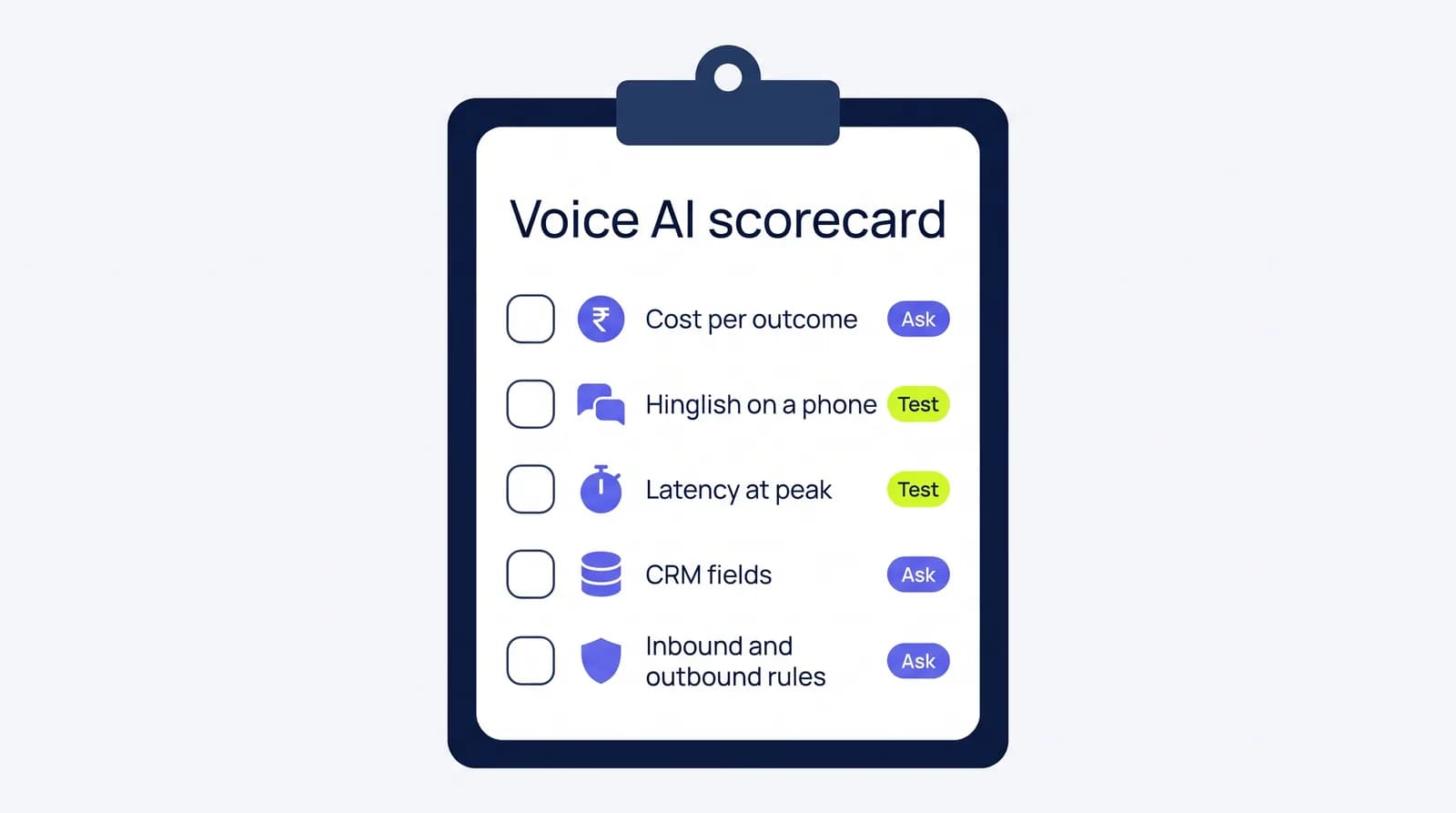
Run the scorecard on one call type for a month before adding a second. The same approach works for first-round telephonic interviews and for voice calls from your website.
Quick answers
How much does an AI voice call cost in India?
AI voice calls in India are usually priced between ₹1.5 and ₹10 per connected minute, depending on volume, languages and what is included. Compare vendors on cost per completed task, not per minute.
Can voice AI understand Hinglish?
Good platforms can follow a caller who switches between Hindi and English in the same sentence, but quality varies by vendor and by phone line. Test with real phone audio, your own product names, numbers and dates, and check that the CRM summary comes out in clean English.
What latency is acceptable for a voice AI agent?
People answer each other within a fraction of a second, so any pause longer than that is noticed. Measure the gap from the end of the caller's sentence to the agent's first sound on a real phone call, in every language you need, at peak load and with a live lookup.
What does CRM write-back mean for a voice agent?
The agent writes the result of each call into CRM fields: the contact matched by phone number, the answers to your questions, a summary, a score, the next step and a deal when the caller qualifies. A transcript attached to a contact is not write-back.
Which Indian languages can a voice AI agent speak?
It depends on the platform. Ours speaks English, Hindi, Marathi, Tamil, Telugu and Kannada, and follows callers who mix Hindi and English. Test each language with your own callers before relying on it.
Is inbound or outbound voice AI easier to start with in India?
Inbound. Answering your own phone needs an AI disclosure, a recording notice and the caller's consent, but no DLT registration. Outbound commercial calls add DLT registration, DND scrubbing and the 9am to 9pm window for promotional calls.